Dinner is over, the plates are cleared, and you start rinsing the kitchen sink. Water disappears down the drain without hesitation. Then a few food scraps reach the garbage disposal, and everything changes. The unit hums. Maybe it turns slowly. Perhaps it sounds normal until food reaches the grinding chamber, then suddenly seems to lose strength.
For an Englewood homeowner, that combination can be confusing. If water drains, shouldn’t the disposal be working?
Not necessarily.
Experienced plumbers in Englewood separate two functions when investigating this complaint. The ability of water to travel through the plumbing and the ability of the disposal’s motor-driven components to process food. One can work while the other starts failing.
The First Diagnostic Clue: Water Flow Is Not Grinding Power
Think of the disposal as a piece of mechanical equipment installed in the middle of a drainage pathway.
Water needs an open route through the disposal, discharge pipe, P-trap, and connected drain. Food waste requires something more. The motor must create enough force to operate the rotating assembly while the impellers move food against the grind ring.
That difference explains a surprisingly common kitchen problem.
If water leaves the sink normally but ordinary food scraps remain poorly processed, the drainage pathway may still be open. The disposal itself deserves closer attention.
The reverse situation also tells a plumber something useful. A disposal that grinds effectively while water pools in the sink can point toward a restriction farther along the drainage system.
Instead of treating every disposal complaint as a clogged drain, the symptoms need to be separated.
Listen Before Assuming the Disposal Has Failed
A disposal often provides audible clues about what is happening inside it.
Humming Without Normal Grinding
A steady hum usually tells you that the unit is receiving power, but something may be preventing normal rotation. A foreign object, jammed mechanism, or excessive mechanical resistance can create this symptom.
Repeatedly switching a humming disposal on is not a useful test. The motor can continue drawing power while struggling to rotate, increasing heat and potentially activating the overload protector.
Normal Sound Until Food Enters
This pattern deserves a different interpretation.
Running empty places relatively little demand on the disposal. Food introduces resistance. If the disposal suddenly slows or struggles under an ordinary load, a plumber may investigate restricted movement, internal wear, or motor performance.
Metallic Rattling
A sudden metallic sound can suggest that something entered the chamber that does not belong there. Utensils, hard food objects, glass, or other debris may interfere with the rotating components.
Complete Silence
Silence changes the diagnostic path altogether.
The wall switch, circuit breaker, reset mechanism, electrical supply, wiring, overload protection, and motor may require evaluation.
The sound does not provide a complete diagnosis, but it helps determine where troubleshooting should begin.
Why a Disposal Can Seem Strong Until You Add Food
A useful comparison is a vehicle engine idling normally but struggling when asked to climb a hill.
The fact that the engine can idle does not prove that it can perform properly under load.
A garbage disposal behaves similarly.
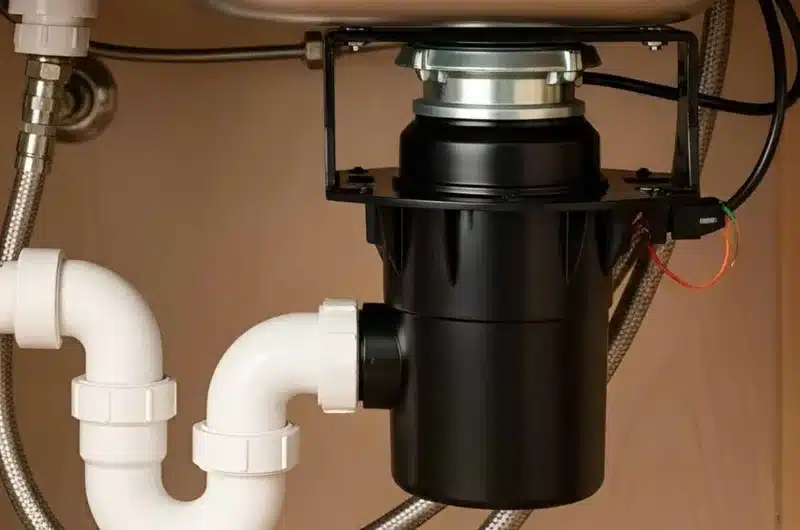
When empty, its rotating components encounter limited resistance. Once food reaches the chamber, the motor has actual work to perform. A unit that loses performance only under load may have:
- restricted movement within the grinding assembly
- a partially lodged object
- deteriorating internal components
- excessive friction or resistance
- overheating under normal operation
- declining motor performance
That does not automatically establish motor failure. It simply means that “it still turns” is not enough information to judge the unit’s condition.
What Garbage Disposal Problems Can Cause Poor Performance?
A garbage disposal does not need to stop completely before something is wrong. Some problems reduce grinding performance while still allowing water to pass through the unit. Others affect drainage, electrical operation, or the connections surrounding the disposal.
Understanding these differences can help explain why a disposal may appear functional at first but perform poorly during normal kitchen use.
1. A Partial Jam Can Restrict Movement
Not every jam completely locks the disposal.
A small piece of hard food waste or another foreign object can interfere with movement without preventing the mechanism from turning altogether. The disposal may sound relatively normal when empty but slow down, vibrate, or make unusual noises once food enters the chamber.
This partial restriction also increases the workload on the motor. If the problem continues, the unit may overheat or activate its overload protection.
2. Worn Grinding Components Can Leave Food Behind
Garbage disposals do not use sharp spinning blades like a blender. Instead, rotating components force food waste against a stationary grind ring, breaking the material into smaller particles that can move through the discharge opening.
Wear within this system can reduce processing performance.
One clue is a disposal that runs and sounds operational but takes increasingly longer to process the same types of food. Larger particles may remain in the chamber even though water continues draining.
This symptom differs from a simple drain blockage because the problem occurs before the food waste successfully leaves the disposal.
3. Foreign Objects Can Cause Noise and Intermittent Problems
Small utensils, broken glass, bottle caps, hard food objects, and other materials can accidentally enter the disposal.
Depending on where the object settles, it may cause:
- metallic rattling or scraping
- intermittent grinding noises
- vibration
- restricted movement
- repeated jams
- reduced performance under load
A foreign object should not be removed by reaching into the disposal. The electrical supply should be disconnected according to the manufacturer’s instructions before any approved inspection or troubleshooting procedure.
4. A Restriction Can Develop Near the Disposal Outlet
Sometimes the disposal processes food, but waste does not move efficiently into the connected plumbing.
Accumulation can develop around the disposal’s discharge opening, discharge pipe, P-trap, or farther downstream. In this situation, the disposal itself may still operate while water begins draining more slowly or backs up after the unit runs.
This is one reason plumbers in Englewood evaluate the disposal and its connected piping instead of assuming that every symptom requires garbage disposal repair.
Where the restriction occurs matters when deciding what actually needs service.
5. Motor Problems Can Appear Under Load
A disposal motor can experience trouble before it stops operating entirely.
The unit may start normally and maintain speed while empty, yet struggle when food creates resistance. Repeated overheating, abnormal noises, frequent overload trips, or progressively weaker performance can justify further evaluation.
These symptoms do not automatically prove that the motor has failed. A partial jam or excessive mechanical resistance can create similar behavior. A proper diagnosis should rule out those possibilities before replacement is recommended.
6. Electrical Problems Can Mimic Mechanical Failure
A silent disposal does not necessarily have a failed motor.
The problem may involve the wall switch, circuit breaker, reset mechanism, electrical connection, wiring, overload protection, or another part of the power supply.
Electrical troubleshooting requires additional caution because the disposal combines electricity, water, and moving components. When basic manufacturer-approved checks do not restore normal operation, professional evaluation provides a safer next step.
7. Leaks Can Develop at Several Connections
Poor grinding is not the only reason a disposal may require attention.
Water can escape around the sink flange, dishwasher connection, discharge connection, mounting assembly, or the disposal housing itself. Determining the exact source matters because not every leak requires replacement.
A loose or deteriorated external connection may be repairable. Leakage through a deteriorated disposal body can make replacement the more practical option.
8. Installation Problems Can Affect a Newer Disposal Too
A relatively new disposal can still develop performance problems when the surrounding installation is not correct.
Discharge alignment, mounting condition, electrical connections, dishwasher routing, available cabinet space, and the configuration of the connected plumbing can all influence operation.
That is why replacing the disposal alone does not necessarily correct every recurring problem. Proper garbage disposal installation in Englewood, Colorado should account for the disposal, sink, electrical supply, dishwasher connection, and drainage arrangement as one connected system.
When a newer disposal repeatedly leaks, vibrates, drains poorly, or develops connection problems, inspecting the installation can be just as important as inspecting the unit itself.
The Reset Button Is a Clue, Not a Repair
Many garbage disposals include thermal overload protection. When the motor becomes excessively hot or encounters abnormal resistance, the protective mechanism can interrupt operation.
After the unit cools, following the manufacturer’s reset procedure may restore power.
A single overload caused by an identifiable event can be one thing. A reset button that repeatedly trips tells a different story.
Something continues to place abnormal demand on the disposal.
That could involve a persistent obstruction, excessive mechanical resistance, overheating, an electrical fault, or deterioration within the unit.
Pressing the reset button again may restore operation temporarily. It does not remove the reason the protection activated.
Disposal Problem or Drain Problem? Follow the Behavior
Homeowners can learn quite a bit by observing what happens before, during, and after the disposal runs.
Water drains freely, but food remains:
The grinding mechanism deserves attention.
Food processes normally, but water drains slowly:
The restriction may sit in the discharge piping, P-trap, or farther downstream.
The unit hums and nothing moves:
A jam or restricted rotating assembly becomes an important possibility.
The disposal works empty but struggles with normal scraps:
The problem appears when mechanical load increases.
Both grinding and drainage have deteriorated:
The disposal and connected drain system may both require inspection.
This distinction can prevent unnecessary replacement. A drainage restriction should not automatically lead to a new disposal, just as a failing grinding mechanism should not automatically be treated as an ordinary clogged sink. Experienced plumbers can evaluate both sides of the system when the symptoms do not clearly point to either the disposal or the connected drain.
What Can Safely Be Checked Without Reaching Inside?
Safety matters more than identifying the problem quickly.
Never put your hand into the disposal chamber, even when the wall switch appears to be off. Disconnect power according to the manufacturer’s instructions before inspecting or attempting any approved troubleshooting procedure.
A homeowner can check whether the breaker has tripped and, after the disposal has cooled, determine whether its reset button has activated. You can also look from above for an obvious foreign object without reaching into the chamber.
Some models provide a manufacturer-approved method for manually rotating the mechanism from underneath the disposal. Follow only the procedure specified for your particular model and use the recommended tool.
Stop troubleshooting when the unit repeatedly overloads, refuses to move according to the manufacturer’s procedure, leaks from its body, or resumes the same behavior shortly after being reset.
At that point, professional garbage disposal repair can help determine whether the problem remains serviceable.
When Does Garbage Disposal Repair Still Make Sense?
Not every struggling disposal belongs in the trash.
A relatively new unit with one removable obstruction presents a very different situation from an older disposal with corrosion, repeated overloads, leaks, and progressively weaker grinding. Before recommending replacement, plumbers in Englewood can check whether the trouble comes from an isolated, serviceable problem or broader deterioration within the unit.
Repair may remain practical when a plumber finds an isolated problem such as a removable foreign object, loose connection, sink-flange issue, dishwasher connection problem, discharge alignment concern, or another serviceable fault.
The decision should consider more than whether someone can make the disposal spin again.
A worthwhile repair should restore dependable operation.
Signs the Entire Unit May Be Reaching Its Limit
Replacement becomes more reasonable when several problems begin appearing together.
Persistent motor trouble, internal housing leaks, extensive corrosion, repeated jams, frequent overload trips, and poor grinding after obvious restrictions have been eliminated can indicate broader deterioration.
Age provides context, but it should not serve as the only deciding factor.
Condition matters more.
A heavily used disposal may deteriorate differently from another unit of the same age. Installation quality, usage habits, maintenance, foreign objects, and the condition of connected plumbing can all influence service life.
Garbage Disposal Installation Requires More Than Horsepower
If replacement becomes the practical choice, homeowners sometimes focus immediately on motor size.
Residential units commonly include 1/2 HP, 3/4 HP, and 1 HP options. Bigger, however, does not automatically mean better for every kitchen.
Before garbage disposal installation in Englewood, the existing setup should be considered as a complete system.
That includes available cabinet space, sink and mounting configuration, discharge alignment, electrical requirements, dishwasher connection when applicable, and existing drainage arrangement.
Household usage also matters. A kitchen that frequently handles food preparation may place different demands on a disposal than a lightly used kitchen.
Proper installation also creates an opportunity to address deteriorated connections, alignment problems, or existing leaks before they affect the replacement unit.
Frequently asked questions
Can water drain through a broken garbage disposal?
Yes. Water can sometimes travel through the disposal and drainage piping even when the motor-driven grinding mechanism does not function properly.
Why does my disposal hum instead of grinding?
Humming can indicate that the unit receives electricity while normal rotation remains restricted. A jam or foreign object represents one possible cause. Switch the unit off rather than repeatedly attempting to run it.
Why does the disposal only struggle when food enters?
Food places additional mechanical load on the motor and grinding assembly. Restricted movement, wear, excessive resistance, overheating, or declining motor performance may become noticeable only under load.
Does repeatedly pressing the reset button damage the disposal?
More importantly, repeated resets can indicate an unresolved underlying problem. Identify why the overload protection continues activating instead of treating the reset button as a permanent solution.
Does slow sink drainage mean I need a new disposal?
Not necessarily. If the disposal processes food normally while water drains slowly, a restriction may exist in the discharge pipe, P-trap, or downstream plumbing.
A Weak Disposal Usually Gives Warnings Before It Stops
Complete failure is not always the first sign of trouble.
Sometimes the warning is subtle: food takes longer to process. The unit sounds different under load. The reset button starts appearing more often. A disposal that once handled routine cleanup easily begins struggling with the same tasks.
Those changes provide an opportunity to investigate the unit before it quits completely.
A Clear Choice Plumbing and Heating provides Garbage Disposal Installation & Repair in Englewood and can evaluate whether the problem comes from an obstruction, connected plumbing, electrical issue, mechanical deterioration, or a disposal that no longer makes economic sense to repair.
If your disposal still passes water but no longer handles food the way it should, call +1 7209381554 to schedule an evaluation.